




A Brief History of Women at Asbury Theological Seminary: Part 2
This article is the second of three parts. The first part can be read HERE.
The 1970s: A Low Point for Women at Asbury Theological Seminary, But the Beginning of Change
Throughout most of the 1950s and 1960s the number of women seeking degrees remained low (under 10%) with a larger number of women auditing classes (likely as the spouses of male students). Even by 1980, there were 37 women auditors compared to only 3 men. The lowest point was reached in 1971 when only 2% of the students seeking degrees were women. There were 18 women students out of 431 total students in 1971. Only two women were seeking the Master of Divinity (0.4%) and eight for the Master of Arts in Religious Education (1.8%). The remaining 8 were auditors not taking classes for a degree. In much of the 1970s, women degree-seeking students made up less than 10% of the entire student population.
Things became so difficult at one point in the early 1970s that there were only 10 women living in the only women’s dorm, Ely-MacIntyre, and the top floor was used to house male students. One graduate even related how Grace Ely, the Dean of Women at the time, had closed off access from the third floor, so that the men had to enter and leave the building via the fire escape stairs outside the building.7 Yet, even at this point, the 1970s was also the time when the seeds of the next generation of women at Asbury were being planted.
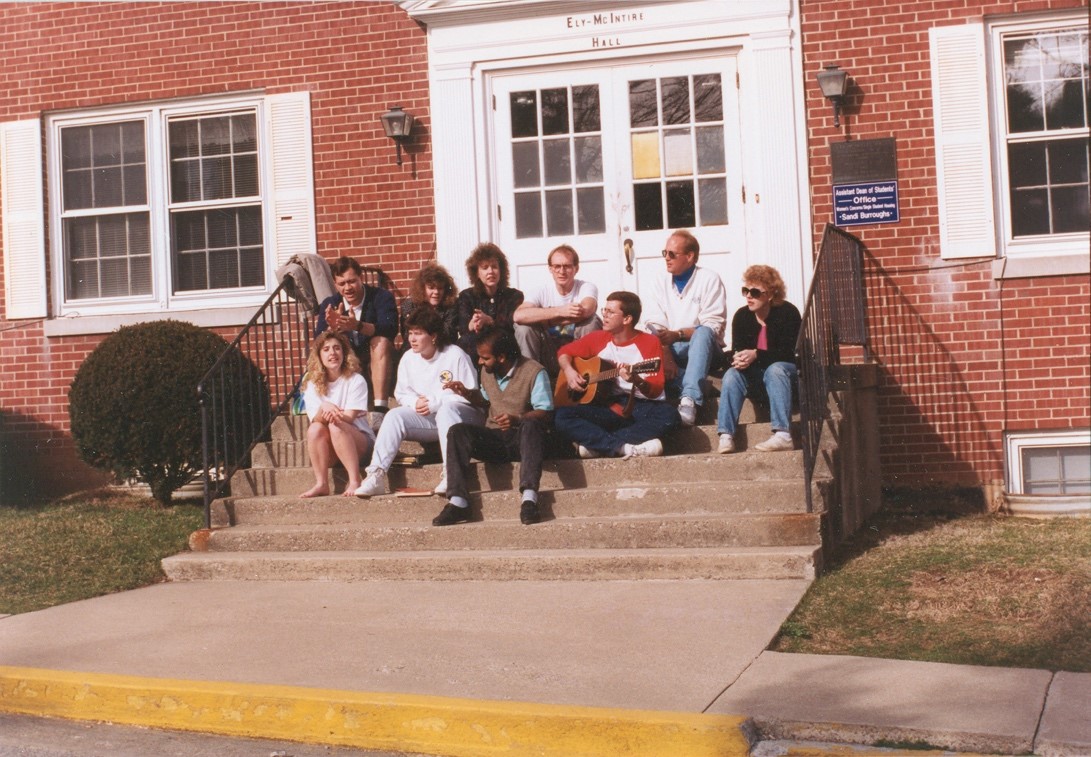
Women and men students outside Ely-McIntire, the women’s dormitory about 1989. The blue sign on the right notes the Office of Women’s Concerns, at the time listing Sandi Burroughs as director, a position she served from 1988-1990. (Image used courtesy of the Archives of Asbury Theological Seminary).
In March of 1971 signs of a change had begun. Tedi Reynolds, a woman student serving on the editorial board of the student publication, The Short Circuit wrote,
Being an institutional embarrassment is an unusual position to be in. What do you do with 14 women students among 450 men? Well, you can relegate them to baby news and recipes for one thing. Sorry, fellows, but that’s not my thing! The Christian woman has a definite role in society today, and all of us better recognize it before we set out in ministry.8
By 1972, Lucille Sider Dayton published a major article entitled “The Feminist Movement and Scripture”9 in the same student publication, which had moved from an institutional noticeboard in the 1960s to a place for students to voice concerns and issues. Such individual voices continued until 1974.
Several other women students had been involved in a summer urban experience with students from other seminaries in 1974 under Dr. Gilbert James. This experience had the theme of “human liberation” and Asbury students had been challenged on the role of women in ministry, and this was also reported in The Short Circuit. In the Fall of 1974, the Seminary started events for the term with the Holiness Emphasis Conference with a discussion on the theology of love. Dr. Gilbert James was one part of this conference, but the other part was the renowned holiness theologian, Dr. Mildred Bangs Wynkoop.
In a letter to the Board of Trustees, Student Body President Fred Price wrote about the influence of this presentation. In the following paragraph he noted, “One of the most interesting developments of the year has been a continuing dialogue concerning women’s rights and women in the church. A number of students found it necessary to reconsider their thoughts and theologies concerning women.”10 When questioned about a connection 50 years after the fact, Fred Price affirmed that there was a connection between Dr. Wynkoop and the increased discussions on women in ministry. Price wrote in 2025, “Mildred Wynkoop was an authority and spoke with authority. That was a challenge to the presuppositions held by some regarding women at the time.”11

Another watershed moment was when Dr. Mildred Bangs Wynkoop, the noted Holiness theologian spoke in chapel on the theology of love in 1974. Her authority convinced many male students of the idea of women in ministry. (Image used courtesy of the Archives of Asbury Theological Seminary).
The conversation continued to escalate into 1975. An editorial from March 1975, entitled “The ATS Caste System” noted,
Although significant progress has been made in achieving equality for women in many areas of our society, the church is unfortunately lagging behind as usual. Asbury Seminary is no exception. The pattern of hiring reflected in the present faculty and administration demonstrates that there still exists a lack of trust in the leadership ability of women.
Of the thirty-three members of the faculty, there is one woman; over three-fourths of the administrative officers are men; there are no women Trustees.
We hear a lot of support for women, but we don’t see much. The seminary has the opportunity to set a significant example to the church and the world. Asbury Theological Seminary has avoided committing itself on this issue for too long.12
While things seem to quiet down a bit in terms of student voices, things were beginning to change, but this time at the top in the Board of Trustees.
In 1978, 32 years after the death of Bettie Morrison, Asbury selected its second female member of the Board of Trustees, Evelyn Kuttler, a lawyer from St. Petersburg, Florida. Evelyn Kuttler is really at the heart of the story of a massive transition which occurred from about 1985 to 2003 and she has been called a “force” in the advancement of women at the Seminary by several sources. While Kuttler was brought on the Board during the presidency of Frank Stanger, she does not recall him having any position on the issue of women when he brought her on the Board.13 As she came on, she faced at least one Board Member who was directly opposed to any woman coming on the Board. She related in an interview that she reached across the table and told him, “This is my first time at this too, so maybe we can just see how it goes?” The key person to bring Evelyn Kuttler on the Board was another Board member, John Grant, a lawyer from Tampa, Florida who knew Evelyn and her husband. He felt it was time for a woman to be brought on as a Trustee, and he led the fight for her and encouraged her to apply.
As a law student, Evelyn had been the only woman in her class to graduate in a large field of men in 1964. Another woman who had been a part of the class had committed suicide. This made Evelyn especially conscious of the situation many women felt in the educational sector. Before her first meeting with the Board, she requested to meet with women students, and she did this several times afterwards. The biggest problem as she saw it, was that women students in the cafeteria felt they had to constantly defend their call into ministry and were often challenged by more conservative male students. Evelyn wanted to see an end to these “hermeneutical battles.” While Evelyn was not raised in a strong church-going family, she had a strong interest (and still does) in theology. Attending the Evangelical Women’s Caucus in 1974 really opened her eyes to seeing Jesus as a liberator of women and not an oppressor. So, as she came on the Board, Evelyn took up the challenge of helping women at Asbury Theological Seminary. She notes, “When I’m passionate about something I go for it, but with gentleness and humor… lots of humor.”

Evelyn Kuttler, the first woman elected to the Board of Trustees since Bettie Morrison, was the primary force which drove the administration to focus on the needs of women students. She served on the Board of Trustees from 1978 to 2003. (Image used courtesy of the Archives of Asbury Theological Seminary).
At the same time Evelyn Kuttler was coming on the Board in 1978, the last full-time faculty member from 1949, Susan A. Shultz, the librarian, retired. While Shultz did not teach many classes, her role was formidable. According to one source, she enjoyed being the only woman on the faculty, and President Stanger would frequently visit her office to discuss problems he faced in running the Seminary. In this sense, it was a bit of an ironic changing of the guards which led to massive change. By 1979, Evelyn Kuttler was appointed chairperson of the Board of Trustees Ad Hoc Committee on Women of the Asbury Seminary Community, and her work on transforming the Seminary had begun.
In a 1979 memo to the Board of Trustees (likely at Evelyn Kuttler’s request) the administration sent an evaluation of the current situation and proposed goals for “ATS Role in Educating Clergy Women.”14 Two situations make an immediate impact. The first is, “There is no role model of a woman minister in full connection immediately available on the faculty or staff of the Seminary nor is one available in the Kentucky conference.” The second is, “There is no single woman minister readily available in the Wilmore community or nearby who could serve as a counselor to the women in the M.Div. program.” While the presence of women students had improved from 1971, the situation was still not good.
Changing the Roles of Women at Asbury (1980-2000)
By 1980, Evelyn Kuttler’s committee recommended a standing faculty committee with three goals:
“1. To develop faculty awareness of the needs of women students, women staff members and students’ wives.
2. To identify prospects for female faculty and staff.
3. To develop systems to recruit women students.”15
In November of 1981 the Board of Trustees Committee held a join meeting with the faculty Task Force on Women in the ATS Community, chaired by Harold Burgess. Margaret Dunn, secretary of the student council, was also on the Board committee with Evelyn Kuttler. A number of potential goals were outlined to meet some of the identified needs. The top goals included hiring full-time qualified women faculty, finding more visibility for women in worship services, developing courses and workshops about women in ministry,16 and instituting “inclusive language” in the Seminary. Dunn wrote up a report in 1984 on a Chi Alpha forum to discuss progress on these goals.17 Only two of the goals were making concrete progress. The first, was the hiring of Helen Musick to be the founding director of the Office of Women’s Concerns in 1985. The second advance was for a formal Seminary policy on women in ministry to be added to the academic catalog in 1985. It read,
“Asbury Theological Seminary affirms the role of women in ministry. Thus, the seminary aims to create a climate in which women are encouraged in their progress toward professional ministry goals and enabled in their spiritual development.”
By 1984, Evelyn Kuttler would be joined on the Board of Trustees by two other women, Ann Kiemel Anderson and Kathryn Chatios Randle. Ann Kiemel Anderson was a well-known speaker in her day whose work focused on encouraging women. In the same year, the Board of Trustees (likely following Kuttler’s committee work) created a policy and goals document and created an Ad Hoc committee to discuss the implementation of these ideas. The first goal was that “Competent women to fill significant faculty positions must be identified, recruited, and, when necessary, assisted in academic preparation.” The second goal was that “Recruitment of women students must become a priority.” By February of 1984 a standing faculty committee of women’s concerns had been formed with the only female faculty member being a visiting instructor in Christian Education, Helen Musick.
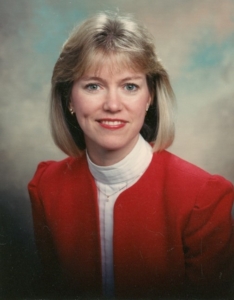
Helen Musick began her connection with the Seminary as a Visiting Instructor in Christian Education. In this role she would be the only woman to sit on the standing faculty Committee on Women’s Concerns. She would become the first Director of the Office of Women’s Concerns in 1985, and she would work to shape the office to meet the needs of women studying for the ministry. (Image used courtesy of the Archives of Asbury Theological Seminary).
It was also in 1983 and 1984 that Asbury Theological Seminary had its first African American women students. While Bernadette Barr who started in 1983 would not graduate, Gwendolyn Wilson who came in 1984 would be the first African American woman to graduate from the Seminary in 1987. She would also go with Helen Musick to the 1986 Women’s Inter-Seminary Conference in Denver, as part of the work of the Office of Women’s Concerns. According to Helen Musick and Gwendolyn Wilson, this conference was quite eye-opening, and full of many ideas common in more liberal settings. For Musick, this was not the direction she wished to go. Having been a woman student at Asbury in the 1970s, Musick wanted to develop the Office of Women’s Concerns into something which could encourage and empower women in ministry. She would thus shape the direction of the office for the future by developing women’s chapels, women’s forums, and encouraging visiting speakers on women’s issues.
However, change had also been pushed by the denominational organizations which provided the Seminary students. In 1968, the formation of the United Methodist Church reaffirmed the full clergy rights of women and by 1972 created the Commission on the Status and Role of Women. The Free Methodist General Conference of 1974 officially gave women clergy an equal status with men. As denominational moves continued into the 1980s, there was a growing need to change the situation.
At the same time as the forming of the Office of Women’s Concerns in 1985, the Provost, Mel Deiter, reached out to Jo Anne Lyon, an active Wesleyan pastor who was involved in women’s issues in the Christian Holiness Association. She agreed to come as a visiting instructor in Women’s Studies to teach one class a semester while commuting twice a semester from her place of ministry. Jo Anne has noted that she was hired in part because of pressure from the United Methodist Church about new pastors from Asbury not being knowledgeable in “alternative theologies” such as feminist theology.
The newly formed Office of Women’s Concerns would become the Office of Women’s Studies, and this organization actively sought to find ways to encourage and empower women students for ministry. Leaders in this office included Sandi Burroughs, Barbara Minton, Melanie Beachy, Barbara Holsinger, and Margi Galloway. The development of women’s chapels and women’s forums invited Christian women with leadership positions into the Seminary, while classes in women’s studies, and a push for inclusive language were also key projects of the office. The Office of Women’s Concerns was originally housed in Ely-McIntire, the women’s dormitory on campus, which kept it close to the women it sought to serve.
By 1987 the Seminary hired Dr. Catherine Stonehouse as a full-time professor in Christian Education and one of the most dramatic shifts in the student body at Asbury Theological Seminary was underway. From 1985 to 2005, the percentage of women degree-seeking students rose from 11% to 34% in just 20 years. This growth in women students directly correlates with the growth in women faculty. By 2005, there were thirteen full-time women on the faculty in all areas of the Seminary. This was the highest number in the history of the Seminary to date. There is not a clear cut off point, but the women hired by 2000 can be viewed as the second generation of women faculty at Asbury Seminary, and they can be held mostly responsible for the rapid growth of women students.
Dr. Catherine Stonehouse was just the first of these women. With experience in the field of Christian Education, she had served as the general director of Christian Education for the Free Methodist Church of North America for fifteen years. Her passion for her field is revealed in her books Patterns on Moral Development and Joining Children on the Spiritual Journey.

After a significant amount of time with no women on the faculty, Dr. Catherine Stonehouse became the first of the second generation of women faculty at the Seminary in 1987. She was the recognized leader of this group of women and helped create a community to include, encourage, and advocate for women students as well as for women on the faculty. (Image used courtesy of the Archives of Asbury Theological Seminary).
Dr. Christine Pohl was hired in 1989 as the Professor for Church and Society. Her work coordinating services to refugees in New York and serving on the national staff of Bread for the World Educational Fund, led to her formative book Making Room: Recovering Hospitality as a Christian Tradition. She also co-wrote an important book on women in the theological academy, titled Living on the Boundaries: Evangelical Women, Feminism and the Theological Academy. In this book, she shares part of her own story,
Like many women who grew up in mainline Protestant church in the 1960s, I received mixed messages about the significance of gender. I remember thinking, as I walked home from the youth group I loved leading, “If I were a boy, I could become a pastor.” There was some freedom, but little encouragement, for women to pursue theological interest. In my world, there were no models of female pastors. When I moved toward more evangelical settings, the messages were equally mixed, though the ingredients were different. I found myself in leadership positions, especially in teaching roles, but I was usually viewed and treated as “the exception.”18
She also noted,
Teaching at Asbury is different from working in many other evangelical schools because Asbury has had a commitment to training men and women for ministry since its founding. Nevertheless, from the 1960s to 1987, there were no women on the faculty in tenured position (except the librarian), and when I came in 1989, I became the second woman to be on the faculty in a full-time, tenure-track position. Since then, Asbury has added thirteen women to its tenured or tenure-track professors, changing the personal and institutional experience of women significantly. The reality of having more than a token female presence is powerful.19
Dr. Leslie Andrews came in 1990 with a background in Christian Education within the Christian and Missionary Alliance. But while her initial leadership role was as Dean of the Doctor of Ministry program, she ended up as the Provost of the Seminary and played a key role in the administration of the Seminary.
When Dr. Eunice Irwin arrived in 1994, she brought a wealth of mission experience among the Lupuyan Subanen tribe of the Philippines where she served for the Christian and Missionary Alliance. Having studied under Harold Turner at the University of Birmingham, she was an expert on primal religions, new religious movements, and contextual theology.
Dr. Mary Fisher was originally from Australia, and while she came in 1994, she then took a four-year study leave to do Ph.D. level work in Biblical Theology, which she taught on her return in 1999 from England. She was an expert on Chinese culture and evangelization. She had also served as an associate director of InterVarsity Missions and URBANA, while also serving the Christian and Missionary Alliance.
Dr. Virginia “Toddy” Holeman came to Asbury in 1995 as an experienced counselor in marriage and family therapy. Known for her passion for the concept of forgiveness, she would rise to become the head of the School of Counseling before she retired.
Dr. Ruth Anne Reese arrived at Asbury in 2000 after earning her Ph.D. from the University of Sheffield. She had also been involved in academic editing and teaching. She is known for her published works on Jude, 2 Peter and other commentaries. As a scholar in New Testament Biblical Studies, she is the only one of this group of professors still actively teaching at the Seminary as of 2026.
Dr. Sandra Richter came as an Old Testament Biblical scholar straight from her Ph.D. work at Harvard University in 2000. She is most widely known for her books The Epic of Eden: A Christian Entry into the Old Testament and The Stewards of Eden: What Scripture Says About the Environment and Why it Matters. She also produced a video on Women in Ministry at the Seminary which has been widely used on campus over the years.
Finally, Helen Musick returned in 2000 for one year as a full-time instructor in Youth Ministry, coming full circle from her time as the first director of the Office of Women’s Concerns.
In listening to the memories of people connected with this group, several items really come to the forefront. First, many of this generation were older women scholars who were not married. There was often a feeling at this time that women could not have an academic career and a family. These women had all invested heavily in their academic careers. As a result, these women bonded into a tight social group, often joining together for celebrations, meals, and even occasional retreats. It was the practice at Christmas for the women to go to their various houses and help decorate each other’s Christmas trees. Frequently, I have heard that Cathy Stonehouse was the undisputed leader, but that Christine Pohl’s view of hospitality was frequently lived out in this group as well. Likewise, I remember Eunice Irwin telling me how she attended Leslie Andrews and Christine Pohl in their final sicknesses before they died. These women truly formed a family bond and a support system within the larger faculty. Second, most of these women set aside time and energy to invest in mentoring and guiding women students.20 Likewise, newer women faculty all report how the earlier women faculty of this group made them feel welcome and included them as they arrived. They worked to develop a welcoming environment for women at all levels in the Seminary.
The phenomenal growth of women students during the period of the second generation of women faculty is unprecedented in the Seminary’s history, helping to take the number of women degree-seeking students to around 34%.21 However, these numbers stopped rising about 2005 and remained relatively stable at this level for a number of years. While the number of degree-seeking women did ultimately rise slightly to the present number around 40%, the current number of eight full-time women faculty in 2026 represents a decline in the presence of women faculty. This final part of examining the history of women at Asbury Theological Seminary will look at the last 25 years and reflect on the lessons we can learn from the past.
End Notes:
7 The story I was told while interviewing a woman student at the time who lived in the dorm, and her husband-to-be who lived on the top floor, was that Grace Ely not only sealed off the top floor, but she also posted a sign on the men’s side of the locked door with Luke 16:26 posted there: “Besides all this, a wide chasm has been fixed between us, so that those who want to cross from this side to you cannot do so, nor can they cross from your side to us.”
8 “Hen Scratchings” The Short Circuit 18(1) (March 9, 1971): 6.
9 “The Feminist Movement and Scripture” The Short Circuit 19(17) (May 10, 1972): 1-3. Lucille Sider Dayton the wife of Donald Dayton would also work closely with Gilbert James in his urban experiences, and together Lucille and Don Dayton would present an influential paper at the 1974 meeting of the Christian Holiness Association called “Women in the Holiness Movement” which outlined the historic role women played in the movement as a foundation for being more open to women in ministry. Jo Anne Lyon has described the presentation of this paper as a major moment for women in the Holiness Movement. It was subsequently published as “’Your Daughters Shall Prophesy’: Feminism in the Holiness Movement” by Lucille Sider Dayton and Donald W. Dayton in Methodist History 14(2) January:67-92.
10 This letter is found in the Board of Trustees minutes for 1974-1975, appendix F-1.
11 Personnel email from Fred Price dated May 30, 2025.
12 “The ATS Caste System” The Short Circuit 22(7) (March 12, 1975): 6.
13 Most of the information about Evelyn Kuttler comes from either internal documents from the Archives (Board of Trustees papers or materials in the Papers of the Office of Women’s Concerns) or from a personal telephone interview with her on July 23, 2025, from 6:00-7:00pm.
14 Document from Archives: Proceedings of ATS Board of Trustees Committees: Committee on Women of the Asbury Seminary Community (1979-1981): ARC210-004, box 7, folder 9.
15 “Minutes of the AD Hoc Committee on Women of the Asbury Seminary Community” for November 3, 1980 from Archives: Proceedings of ATS Board of Trustees Committees: Committee on Women of the Asbury Seminary Community (1979-1981): ARC210-004, box 7, folder 9.
16 The earliest known course on women in ministry seems to be a course in 1982 called “The Role and Status of Women in Ministry” which was recorded and seems to have been organized and led by Harold Burgess with numerous other speakers including Donald Joy, Steve Harper, Evelyn Kuttler, and Ann Kiemel Anderson. As part of this class, Kuttler and Anderson met with women students to find out about their needs and concerns as part of a Board taskforce on the issues of women students at Asbury Theological Seminary.
17 “Report: The Role and Status of Women at A.T.S.” Margaret Dunn, The Short Circuit, vol 84, no. 17 (March 10, 1984): 2.
18 Nicola Hoggard Creegan and Christine D. Pohl. Living on the Boundaries: Evangelical Women, Feminism and the Theological Academy. Downers Grove, IL: InterVarsity Press (2005): 19.
19 Ibid., 21.
20 I will add here that Eunice Irwin was my Ph.D. mentor. I never felt that I was treated less, but I could also clearly see her passion for working with women and international students. She went above and beyond what might be expected. She hosted people for meals, especially at Thanksgiving and Christmas, but I especially remember when I married and my wife immigrated from El Salvador. We lived on campus without a car, and Eunice purchased a van to replace her old car, and she used this van for students. One of the first trips she took was to take myself, my new wife, and her nephew Keith on a memorable trip to Memphis, Tennessee. In large part, this was so my wife could visit Graceland, which had always been a dream of hers. But this trip also included exploring Beale Street at night, going to see where Martin Luther King, Jr. was assassinated at the Lorraine Motel, and a memorable Sunday in the African American Pentecostal Church pastored by former musician Al Greene. It was more than I could ever have expected from a Ph.D. mentor, and I am still in awe of her friendship and hospitality.
21 When asked about this figure in an interview, Dr. Joy Moore, who had served as the Director of Student Life at this time, noted that this percentage can be misleading. Smaller schools at the time had higher percentages, but few theological seminaries in the country had such a large number in terms of raw numbers, with over 300 women at Asbury at this time.
Robert A. Danielson is the Director of Strategic Collections and Scholarly Communications Librarian at Asbury Theological Seminary. He has served as a missionary to the People’s Republic of China and done work in El Salvador and Honduras. He also teaches at the E. Stanley Jones School of Missions and Ministry at Asbury Theological Seminary.
When I was a student at ATS (1969-1972), Dr. Susan Schultz was indeed the only female on the faculty staff. If a woman missionary was visiting campus and wanted to address a chapel service, the service was moved from the chapel to the auditorium.
In May of 1972, I was one of five seniors invited to preach during our morning chapel services.
I was the FIRST woman ever to preach in Estes Chapel.
I was glad to finally see my husband’s name in footnote 16. He was such a strong supporter of the education of women and women as educators during his tenure at the at the seminary.