




A Brief History of Women at Asbury Theological Seminary: Part 1
A Brief History of Women at Asbury Theological Seminary1
By: Robert A. Danielson
Abstract:
Understanding the past roles of women within the 100-year lifespan of Asbury Theological Seminary is an important exercise in institutional history. Educational institutions frequently experience turnover in students, faculty, and administration at high rates. Institutional memory frequently is held by a few older members of the faculty and staff and more importantly by the archives of the institution. Institutional memory provides the foundation for changing policy decisions, understanding the institutional mission, and following how previous administrations dealt with a constantly changing cultural and social context. In the case of Asbury Theological Seminary, this paper explores an institution rooted in the Holiness Movement, which historically allowed and promoted women in ministry. Understanding this history in one Holiness institution provides a case study of the process by which the issue of women in ministry developed over a century. Similar studies done by multiple institutions could provide a broader understanding of how the role of women in ministry was conceived by the movement as a whole.
Asbury Theological Seminary started in 1923 and from its start had women on the faculty. While many of the early women taught speech, music, religious education, and served as professional librarians, which were areas more frequently open to women, there were some notable exceptions. Due to the presence of these women and the social and cultural issues of the war years in the 1940s, the number of women students increased dramatically. Throughout the 1950s and 1960s these roles declined until the Seminary reached its low point in 1971. However, student voices, along with an important woman in the Board of Trustees, led to an institutional revaluation of the role of women in ministry and academia leading up to an intentional practice of including more women faculty and highlighting the issues of women at an institutional level. By 2005, the Seminary hit its high-level mark of 13 women on the faculty along with a massive rise in women students. But as institutional commitment waned, the numbers of women faculty fell, and the growth of women students plateaued with very slow growth at the present. This paper seeks to learn from this history and propose lessons which can be learned from the history of the institution itself.
Keywords: Women in ministry, Asbury Theological Seminary, Women in the Holiness Movement, Women faculty, institutional history
Introduction
Exploring the history of an institution like Asbury Theological Seminary often requires trying to break down that history into units which are easier to research, analyze, and develop into a clear historical narrative.2 This history initially began as research into the women who served on the faculty at Asbury Theological Seminary, but the further the research advanced, the more clearly it appeared that such a limited study would be too superficial. Women faculty are closely connected to women students, and both groups are connected to women on the Board of Trustees. Then there are women on staff, who did not fit the clear categories of full-time women faculty, but who were also essential to the story. Thus, this became a history of women at Asbury Theological Seminary over the past one hundred years.
Such a study is useful as it helps see long-term trends and the roles of individuals who were involved in key parts of the story. It also helps see how complex factors work to drive the growth of degree-seeking women students over the years. While women faculty as role models and mentors play a crucial role, it is not the only factor to drive student numbers. However, it is an important enough factor to realize that it is difficult to separate the stories of women students and women faculty, since they often rise and fall together in tandem. But the story of women at Asbury Theological Seminary is a story that provides a rich legacy which needs to be recorded and told, from its foundations to the present.
The Foundations: Bettie Morrison (1866-1945)
Asbury Theological Seminary was very much a product of the Holiness Movement of the late 19th century. It emerged out of Asbury College in 1923, but the College in turn had been deeply influenced by President H.C. Morrison. One important factor of this connection was that women had been an active part of the Holiness tradition from the start. The concept of sanctification was not limited to men, and therefore it was not uncommon for women to be leaders and speakers. Figures like Phoebe Palmer, Hannah Whitall Smith, and Amanda Berry Smith were well-known, but lesser-known women also served as evangelists and camp-meeting speakers. It should not be surprising then, that Bettie Morrison, the third wife of H.C. Morrison, had a great deal of influence over the formation of the Seminary. Unfortunately, in official histories her role is often ignored or under-reported.
Bettie Leichardt was born in 1866 and studied at the Cincinnati Conservatory of Music. She married a physician, Dr. G. W. Whitehead, and had one son before her husband’s early death. Using her skills in music and her professional training, Mrs. Bettie Whitehead was able to serve as a faculty member of Asbury College teaching piano and voice from 1899 to 1902. From Asbury College she continued teaching at Taylor University from 1902 to1905. Topics like music and speech were some of the few fields which were open to women in academia at this time, except for service in all-female schools or colleges, and even then “higher” subjects were still often taught by men.
Mrs. Bettie Whitehead joined the office of The Pentecostal Herald on September 1, 1906, where she worked as an assistant to the editor until she became Assistant Editor in 1911. She worked in this position until she married H.C. Morrison on February 17, 1916, but even after they married, she remained active in the paper and was listed as Associate Editor until her death. Although she became well-known for her children’s column where she responded to children’s letters as “Aunt Bettie,” she functioned as editor, since H.C. Morrison was often occupied elsewhere. The name “Aunt Bettie” stuck with her, and she was often known by that name around Asbury College and later Asbury Theological Seminary.
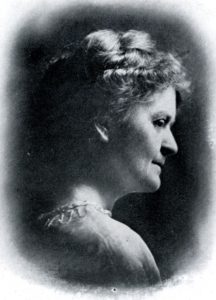
“Aunt Bettie” also traveled with Morrison on his evangelistic trips and often used her musical skills to assist him in his preaching ministry. In 1931, when the Seminary was formally incorporated, Bettie Morrison was the only woman to sign as one of the original trustees,3 and she would become the official treasurer of the Board. She continued in this role even after H.C. Morrison died on March 24, 1942. “Aunt Bettie” worked at raising money for the Morrison Trust for student scholarships and for several planned building projects during her time on the Board. The Board of Trustees even discussed giving her an honorary Doctor of Letters degree, but she turned this offer down. “Aunt Bettie” Morrison officiated at the groundbreaking of the Morrison Administration Building on October 23, 1945, and suffered a heart attack three days later, dying on November 8, 1945. As a woman who had served on the faculty of two Holiness schools, an accomplished editor and fundraiser, her role and influence likely paved the way for the early presence of women faculty at Asbury Theological Seminary. While we do not know how much influence she might have had with H.C. Morrison, it was probably influential.

“Aunt Bettie” Morrison provided a firm foundation for women at Asbury Theological Seminary as the first woman on the Board of Trustees. (Image used courtesy of the Archives of Asbury Theological Seminary).
The Earliest Women Faculty of Asbury Theological Seminary (1923-1939)
In the earliest years of Asbury Theological Seminary, the school functioned more as a department of Asbury College. This meant that classes were shared with students in other degree programs and faculty were also shared. There was not a clear division, and few faculty members were seen as being on the Seminary faculty. Early women faculty were often found in the areas of teaching speech, music, and doing library work, but there were a few women who taught traditionally academic subjects. From the very start of the Seminary in 1923, while it was still a part of Asbury College, the Seminary made use of women faculty members at Asbury College in teaching classes for those taking the Seminary degree.
The first known female faculty member was Daisy Dean Gray, who taught from 1923-1924 and 1927-1938 as Professor of Speech. Current Seminary students would identify this more today as “Preaching,” although at this time it was more about how the future pastor should stand, pronounce words, and speak to be heard and make an impact. The subject was less concerned with the sermon content. Gray studied expression under Dr. Curry of the Curry School of Expression in Boston in 1914. After becoming the principal of Bessie Tift College, Gray spent eight years as the Dean of Women at Meridian Female College before becoming the Director of Expression at Meridian Female College in 1914. The Meridian Colleges in Mississippi were important Holiness schools under the direction of J.W. Beeson, and Beeson’s friendship with H.C. Morrison would be significant through the history of the Seminary.
In 1921 Gray moved to Wilmore, becoming the Director of Expression at Asbury College. In a 1928 article on Daisy Dean Gray in the Asbury Collegian4, it notes “Miss Grays’ interest in the College and her work is manifested in the attempts at establishing a scholarship that students in the seminary might have the opportunity of receiving the training in expression which is very essential for an efficient servant of the Lord.” The article also notes that all the best speakers on campus had experienced some training under Gray.
Daisy Dean Gray received a master’s degree at the University of Michigan in 1931, and she would often spend time in the summers at her home in Cedar Rock, Georgia helping her brother, Dr. Claude Gray in his work as president of the Locust Grove Institute, a Baptist preparation school. In The Mission Messenger5, a paper published in Atlanta in 1902, about 20 years before coming to Wilmore, Daisy Dean Gray wrote an article discussing how she helped start a mission society in her church in Cedar Rock and how she was involved in missions by reaching out to the local African-American community with the Gospel. Daisy Dean Gray died in Vidalia, Georgia on March 12, 1953.
Daisy Dean Gray served on the faculty of Asbury Theological Seminary starting in its first year of 1923. She taught in the area of speech. (Image used courtesy of the Archives of Asbury Theological Seminary).
Another professor “borrowed” from the College to teach in the early Seminary was Hildreth Marie Cross, who taught from 1934-1935 as a Professor of Philosophy and Psychology. Born in March 9, 1901, in Byron, Michigan, Hildreth graduated from Asbury College in 1922 and went on to get a master’s degree from the University of Michigan in 1927 and a Ph.D. at the University of Iowa in 1933, where her dissertation dealt with the issues of stuttering.
Cross taught at Asbury for 17 years, and then Taylor University for 16 years, and finally Azusa Pacific College for three years, before retiring in 1966. She was the author of An Introduction to Psychology: An Evangelical Approach, published in 1952. Dr. Cross died July 7, 1991, in Flint, Michigan. While her work long predated the Seminary’s School of Counseling, the psychological issues of ministry were a concern even at the start of the Seminary.
A third woman faculty member “borrowed” from the college was Mildred L. Stanhope who taught Missions and Spanish at the early Seminary from 1935 to 1938. Stanhope had been a missionary for the Christian and Missionary Alliance in Argentina, Puerto Rico, and Peru, serving from 1920 to 1931. She returned to Asbury College as a student, and then a teacher, earning a master’s degree from the University of Kentucky. Stanhope went on to become the Dean of Women at Nyack College from 1940 until her retirement in 1961. Throughout her teaching career, she taught Spanish and missions. She also founded a touring group of students at Nyack called the Missionary Crusaders, who worked to encourage the importance of missions to churches and other groups. Mildred L. Stanhope died on April 11, 1981, at 86 years of age.
In addition to these three women, several others also are recorded as teaching early Seminary students, even though they were listed as faculty at Asbury College. These include Mary Elizabeth Corley (1932-1934) Assistant Professor of Speech, Ruth Little (1937-1938) Teacher of Speech, and Mary Chamberlain (1939-1940) Professor of English Bible. While very little is known about their role in teaching or the classes they taught, the Holiness view of women did not exclude women from having a certain degree of authority in teaching men within Asbury College and Asbury Theological Seminary from its very foundations.
The First Women on the Full Faculty of ATS (1940-1970)
In 1937 the curriculum of the Seminary was separated from that of Asbury College and in 1939, the physical campus was divided in accordance with the needs of accreditation. The entirety of Asbury Theological Seminary fit into one building, which became known as the Larabee-Morris building. From this period on, the Seminary had its own faculty without needing to “borrow” from Asbury College’s professors. Yet this early faculty also contained several key women.
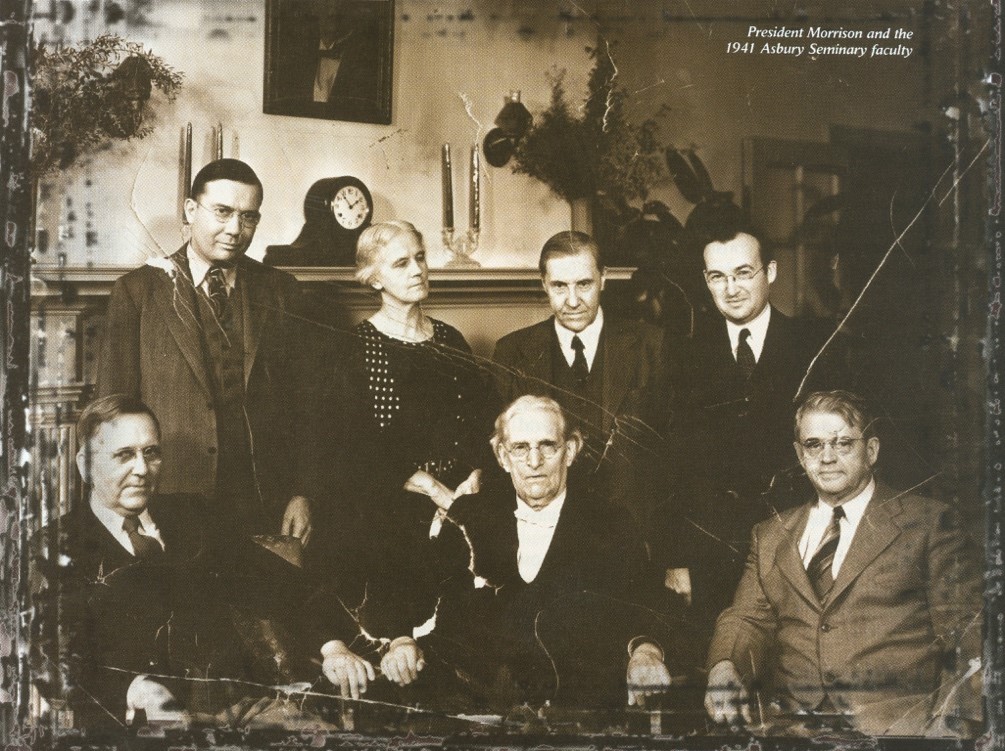
Photo of Asbury Theological Seminary faculty in 1941. In the center of the back row is Gaile and Robert Morris. Gaile Morris was the Professor of Old Testament and Hebrew and played a key role is training students at the Seminary. (Image used courtesy of the Archives of Asbury Theological Seminary).
One of the most well-known and influential women faculty members at Asbury Theological Seminary was Gaile J. Morris, the wife of Frank P. Morris, another early faculty member. She served from 1937 to 1948 as the Professor of Hebrew and Old Testament. After marrying Frank, Gaile served as a pastor’s wife in the North Indiana Conference of the Methodist Church, and as he went on to further education, so did she. She earned a master’s at the University of Kentucky and a Bachelor of Divinity from Asbury Theological Seminary.
She is noted for some of the many students she taught and inspired, including J.T. Seamands, Dennis Kinlaw, Harold Greenlee, and George Livingston, all who became faculty of the Seminary. When Gaile and Frank retired in 1948, they focused their energy on missions in Africa. Gaile Morris was even given a distinguished service award in 1974 by President Stanger. She died in July of 1987 at 105 years of age, and even at that age was known for maintaining a sound mind and keen memory.
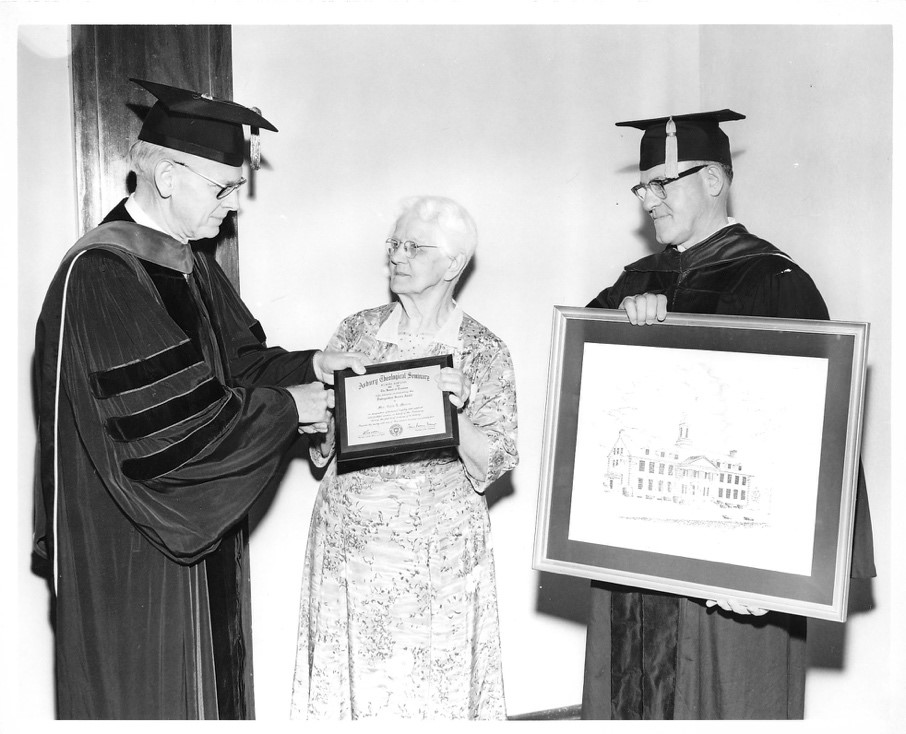
In 1974 President Stanger honored Gaile Morris with a distinguished service award. (Image used courtesy of the Archives of Asbury Theological Seminary).
Ada B. Carroll was the second women faculty member to become part of this new group at Asbury Theological Seminary. She had been “borrowed” from Asbury College from 1937 to 1938 but would become a full professor of the Seminary from 1943 to1962 as the Professor of Music and Speech. She would lead and define the Seminary’s music program and pick up from Daisy Dean Gray in teaching the speaking skills needed for preaching. Throughout the history of the Seminary, women would often serve in the area of music, although often without full faculty recognition or in short temporary assignments, but this was not the case with Ada Carroll.
Carroll was born in Spring Garden, Illinois on July 1, 1891. She graduated from Ruskin Cave College in Nashville in 1921 and did further training at the Chicago Musical College and the American Conservatory of Music. From 1918 to 1921 she worked as Professor of Voice at Olivet College, from 1921 to 1924 at Trevecca College, from 1924 to 1927 at Marion College, from 1927 to 1928 at McKendree College, and from 1928 to 1929 at Des Moines University. She spent part of 1930 travelling in Europe and studying voice and painting. She joined the Asbury College faculty from 1935 till 1943, when she became the Assistant Professor of Music and Speech at Asbury Theological Seminary until her retirement in 1962. She team-taught with President Stanger in preaching, and he noted in her memorial service that he taught “what to preach” and she taught “how to preach it.” Ada B. Carroll died September 5, 1981, in Lexington, Kentucky.
Other women faculty would follow in Carroll’s shoes in teaching music as full faculty. These included: Ruth E. Nussey (1951-1953) Associate Professor of Church Music, and Elizabeth Batten Edwards (1958-1960) Assistant Professor of Church Music (1960-1968 Visiting Professor). Other women would teach in the field of Christian Education (another field often open to women), but without being recognized as full faculty. These included: Verna M. Culver (1956-1966) Teaching Associate in Christian Education, Grace B. Ely (1959-1960) Assistant in Religious Education, and Alice M. Kann (1963-1965) Assistant with Christian Education Fieldwork.
Another interesting woman who taught for a short time without full faculty status was Annie Kartozian, who served briefly as a Professor of the Chinese Language. Kartozian (1906-1989) was an OMS missionary to China. She went to China in 1934, and during World War II she spent 21 months in a Japanese prison camp. In 1943 she left on the diplomatic ship the Gripsholm as part of a prisoner exchange for the United States. She made it back to China after the war, only to barely escape from Beijing in 1949 due to the Communist Revolution. It is likely that her teaching time at the Seminary from 1945 to 1946 was to help her find some type of work until the end of the war would allow her return to China.
Until the late 1980s, professionally trained librarians at Asbury were given faculty status, and this is another area where women served the Seminary as faculty members. The first professional librarian is especially interesting. Lena Barbara Nofcier served in this role from 1945 to 1949. She is credited with organizing the library along the professional guidelines of the Union Catalog instead of its earlier amateur arrangement and moving the library to its first real home in the basement of the Henry Clay Morrison Administration Building in 1947. She had previously served as a librarian at Asbury College in 1925 but went on to get a Library Certificate from the University of Iowa in 1927 and a B.S. in Library Science from the University of Illinois in 1928. She returned at worked at Asbury College’s library until 1930.
However, Nofcier is more well-known in the world of Kentucky libraries for her creative work as the Secretary of the Kentucky Library Commission and for her part in developing the Pack Horse Library Project during the Depression. Working with the Federal Works Project Administration and the Kentucky Parent Teacher Association, she pointed out the need to make reading material available “to all people, rural as well as urban, colored as well as white.” She also argued that Kentucky must, “provide not only adequate library facilities, but also equal library privileges for every citizen.”6

Lena Barbara Nofcier was the first professional librarian on the Seminary faculty. Her work with the Packhorse Librarian Program in Kentucky helped prepare her for organizing the Seminary’s first real library in the Morrison Building basement in 1947. (Image used courtesy of the Archives of Asbury Theological Seminary).
In 1936, through her fund-raising efforts, librarians were sent out on horseback taking reading material throughout rural Appalachia. Given her religious training, it was noted that one of the most requested books was the Bible, and librarians would often take the time to read portions of scripture at people’s request. It has been noted that, “Mounted carriers averaged over 5,000 miles per month visiting over 4,000 families and 55,000 individuals… Four pack horse carriers in Leslie County covered an area greater than the state of Delaware to serve 8,000 people in fifty-seven mountain communities.” Nofcier would leave the Seminary to work in the public library in Lima, Ohio before retiring in 1965.
From 1962 to 1987 (a period of 25 years), the only full-time woman faculty member to appear is Susan A. Schultz, the librarian. Schultz helped plan and work with developers to build the B.L. Fisher Library and move the entire collection to the new building. She also founded the Archives and Special Collections of the Library and trained three young librarians to become leading scholars in the Holiness and Pentecostal Movements. Donald Dayton, David Bundy, and Bill Faupel would become part of the strong academic legacy of Susan Schultz. She would retire in 1978 and marry recently widowed faculty member Delbert Rose. The couple would travel and work on library development and teaching in various parts of the world, before they died, both at the age of 100 years old.
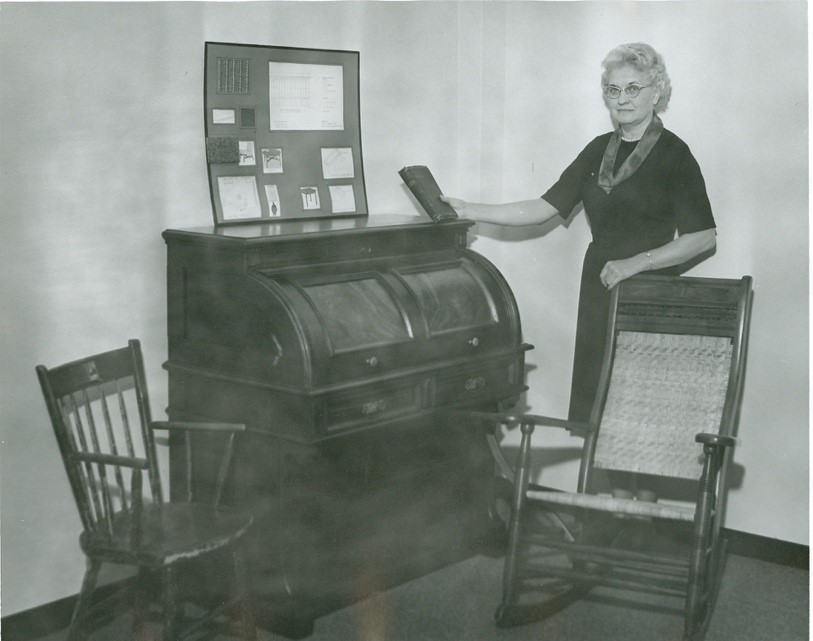
Librarian Susan Schultz would help plan the design and construction of the B.L. Fisher Library, oversee the move to that building, found the archives, and train a group of Holiness-Pentecostal scholars, all as the only woman on the faculty from around 1971 to 1978. There would be no women on the faculty from 1979-1987. (Image used courtesy of the Archives of Asbury Theological Seminary).
Other library workers also had faculty status at this time, and they include: Ollie Mae Williams (1946-1949) Library Cataloger, Ruth A. Warnock (1949-1962) Library Cataloger, and Marilyn Walker Morrison (1965-1971) Library Cataloger. Without these professional women librarians, the current library would not be as strong as it is currently.
By 1947-1949 there were four women with faculty status out of 14 faculty members, representing 29% of the faculty- a number which has never been surpassed in the Seminary to this date. Women students also made up around 22% of the degree seeking students at this time. Organizations of women also began to form, including an organization of the wives of Seminary students, and an organization of the wives of Seminary faculty- called the Seminary Dames. But more importantly, an organization called Chi Alpha was started for women students and staff at the Seminary. With a name standing for their slogan of “Christ First,” Chi Alpha would remain a campus organization into the mid 1980s as a way for women students to build fellowship and develop leadership skills.

The women students and staff in Chi Alpha in 1947-1948. This group developed out of the need to build fellowship and foster leadership skills among women students at Asbury Theological Seminary as the number of degree-seeking women students grew in the late 1940s. (Image used courtesy of the Archives of Asbury Theological Seminary).
The high point of 22% of the degree seeking students being women occurred from 1947-1949, a period which corresponds with having four full-time women faculty members. This is a good argument to support the idea that women faculty serve as valuable role models and mentors which encourage the presence of women students. Immediately after this period, numbers begin to decline. There are likely several factors for this growth and decline. The late 1940s were still part of the years impacted by World War II. There were fewer male students because of the war and there was an increase in openness to women in more non-traditional roles because of the demands of the war. At the end of 1949, the war was over and soldiers were returning home. There was a desire to get back to the “normalcy” of the 1930s and to more traditional roles. While women continue to come to the Seminary, increasingly they were not seeking degrees, but were auditing classes. Numbers seem to indicate that these women were often wives of male Seminary students.
In addition, the most prominent woman faculty member, Gaile Morris retired in 1948. Librarians, Lena Nofcier and Ollie Mae Williams left Asbury in 1949. This left Ada Carroll, in the more traditional role of teaching music and speech and two new librarians, Susan Schultz and Ruth Warnock. With the loss of Morris, the remaining positions could only provide role models for the more traditional roles of women in Holiness academia. Gaile Morris’ position as a core professor in Old Testament and Hebrew was likely a key reason many women students felt it was possible to succeed in their own degree programs.
End Notes:
1 This article is done and dedicated especially to the memory of my Ph.D. mentor, Dr. Eunice Irwin (March 12, 1948 – August 31, 2025). Her love of people, especially international students, and her strong faith in the mission of the Church will always remain with me. She also frequently led a class on women in mission, which I sat in on one year. I know she would have been fascinated by this current research. I also dedicate it to other women mentors in my life, and those at Asbury include Cathy Stonehouse and Christine Pohl. But as a male researching and writing about women at the Seminary it is important to note two other women mentors outside of the church who directed by academic work: Dr. Rochelle Marrinan of Florida State’s Anthropology department and Dr. Fumiko Ikawa-Smith of McGill University’s Anthropology department. I owe so much to the women mentors in my life, and this work is due to all they taught me.
2 Much of the information in this article came from archival materials and official reports of the Seminary, but also from directories and other materials. I am especially thankful and appreciative of those people who allowed me the privilege of interviewing them and often preserving those interviews for the future. These include:
Gwendolyn Wilson (Mar. 4, 2025): https://place.asburyseminary.edu/specialcollectionsvideos/10/
Jo Anne Lyon (June 18, 2025): https://place.asburyseminary.edu/specialcollectionsvideos/11/
Helen Musick (July 26, 2025): https://place.asburyseminary.edu/specialcollectionsvideos/13/
Toddy Holeman (July 8, 2025): https://place.asburyseminary.edu/specialcollectionsvideos/19/
Ruth Anne Reese (June 25, 2005): https://place.asburyseminary.edu/specialcollectionsvideos/12/
Evelyn Kuttler (July 23, 2025) phone interview- not recorded
Stacy Minger (Nov. 14, 2025): https://place.asburyseminary.edu/specialcollectionsvideos/21/
Ellen Marmon (Nov. 18, 2025): https://place.asburyseminary.edu/specialcollectionsvideos/20/
Joy Moore (Feb. 12, 2026): https://place.asburyseminary.edu/specialcollectionsvideos/22/
3 It is important to note that from 1923 to 1932, the Board of Trustees of Asbury College oversaw the work of the emerging Seminary. During this period, the Board of Trustees of Asbury College included: Mrs. J.B. Alford (1923-1924), Grace Crary Haskins (1923-1932), Nannie Metcalf (1923-1925), Jennie Ullendorff Gossett (1926-1928), Lizzie H. Glide (1928-1932), and Mary Harris Armor (1930-1932). These women helped oversee the work of the Seminary in its early years. When the Seminary incorporated, those serving were permitted to either remain on the Asbury College Board or move to the new Seminary Board. None of these women moved over to the Seminary Board. So, while Bettie Morrison was the first women on the official Board of Trustees for the Seminary, at least these six women had served on the College Board when it was directing the early years of the Seminary. Cf. All Things Are Ours, edited by Donald M. Joy (Asbury Theological Seminary: Wilmore, KY) 1974: 118.
It should be noted that Lizzie H. Glide, who founded Glide Memorial Church in San Francisco, California, was a major supporter of Asbury College, and the founding of the Asbury Theological Seminary is also due in part to a sizable gift from Lizzie Glide. The Life Story of Lizzie H. Glide, by Julian C. McPheeters (Eagle Printing Company: San Francisco, CA 1936: 75). In this sense she would count as a major financial supporter of the founding of the Seminary as well as an early Board member.
4 Asbury Collegian Vol. 14, no. 22, March 10, 1928, page 2.
5 The Mission Messenger Vol 6, no. 10 October 1902, page 3,6.
6 Much of this information on Lena Nofcier comes from a longer piece I wrote and published “From the Archives: The Library at Asbury Theological Seminary: The Center of Academic Learning,” The Asbury Journal 78(2) (Fall 2023): 461-487.
Robert A. Danielson is the Director of Strategic Collections and Scholarly Communications Librarian at Asbury Theological Seminary. He has served as a missionary to the People’s Republic of China and done work in El Salvador and Honduras. He also teaches at the E. Stanley Jones School of Missions and Ministry at Asbury Theological Seminary.
Leave a Reply